by
Karen Firestone
Fiscal Analyst
October 1999
The author of this paper would like to thank Lynda Davis for typing as well as creating tables and graphs.
ADMISSIONS TO THE PRISON SYSTEM
Throughout the 1990s, in terms of prison, parole, and probation population size, Michigan has been among the leading states in the country. Yet, the states surrounding Michigan have experienced acute growth in their corrections systems during the decade, while Michigan's corrections system growth has been more measured. Even though Michigan's growth is slower than the growth in the surrounding states, Michigan's prison population has outpaced the prison system capacity available to house the population.
Each week the Department of Corrections (DOC) issues a census of the prison population and the capacity available to house the population. The December 25, 1998 Weekly Prison Population Census Report indicated that there was one available prison bed for male prisoners in secure correctional facilities, 87 men's prison camp beds, and 90 total women's beds available. Currently, the number of prisoners requiring secure male beds exceeds the capacity available in the system, with the excess taken up with prison beds leased from the Commonwealth of Virginia and bunks placed in the day rooms of certain correctional facilities.
The Youth Correctional Facility (YCF), an in-State, privately operated prison, opened in July 1999, with an appropriated average capacity of 480 prisoners, aged 19 years or younger(1). Once qualifying prisoners move from the State prisons into the YCF, prison beds will become available in the facilities previously occupied by these prisoners. In addition, several State- owned and -operated facilities are scheduled to open or reopen during fiscal year (FY) 1999-2000. These additions will increase prison capacity by 5,400 prison beds and allow the State to lapse the lease of 1,550 beds from the Commonwealth of Virginia.
The number of people involved with the corrections system and the growth of the prison system will be a focus of State and local resources for some time to come. Understanding the components of the State adult corrections system and each component's contributions to the growth of the prison system will give shape to the policy concerns surrounding these issues. The divisions between State and local responsibility also will be discussed in this report about the Michigan corrections system.
ADMISSIONS TO THE PRISON SYSTEM
In general, felony offenders are incarcerated
in State facilities when they receive a term of incarceration greater than
one year according to State law(2). With
the enactment of legislative sentencing guidelines, an offender may not
be sent to State prison with a minimum prison term less than 18 months,
unless the judge departs from the guidelines for a substantial and compelling
reason. Although statute gives clear instructions on the length of sentence
that garners a prison commitment, offenders may become incarcerated in
a State facility for reasons other than the length of sentence. Offenders
become incarcerated in State prison facilities in the following manner:
2) Parole Violator New Sentence - An offender currently on parole from a term of incarceration in a State facility commits a new crime for which a circuit court judge sentences the offender to a new term of incarceration.
3) Parole Technical Rule Violator - An offender currently on parole from a term of incarceration in a State facility commits a new crime or a violation of the terms of parole and is returned to a State facility by a parole agent as a technical rule violator.
4) Probationer Violator New Sentence - An offender is sentenced to probation by a circuit court judge and commits a new crime for which a circuit court judge sentences the offender to a new term of incarceration.
5) Probationer Technical Rule Violator - An offender is sentenced to probation by a circuit court judge and commits a new crime or a violation of the terms of probation for which a circuit court judge revokes the probation and sentences the offender on the original charge to incarceration in a State facility.
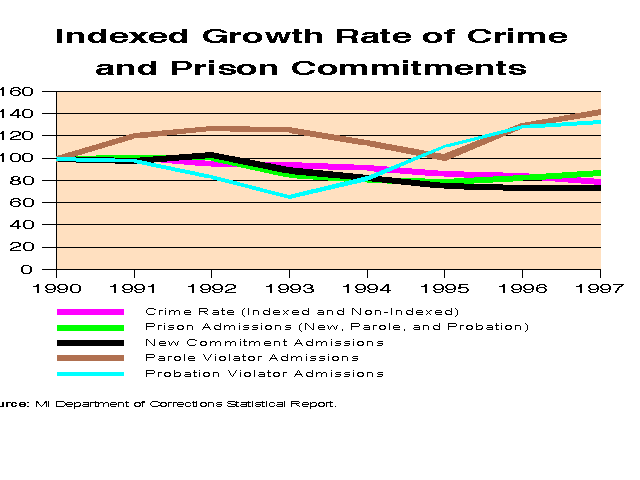
These various types of prison admissions are illustrated in Figure 1, which compares the crime rate(3) per 100,000 Michigan citizens with the prison admissions rate per 100,000 Michigan citizens, and shows the rate per 100,000 Michigan citizens for various components of prison admissions. As seen in Figure 1, the crime rate has declined from 1990 to 1997 by 21%. During the same period, the prison admissions rate has declined 13% and the rate at which new commitments enter prison for the first time has decreased by 26% or double the rate of total prison admissions. The growth in the prison admissions rate results primarily from parole and probation admissions to prison. From 1990 to 1997, these rates have increased 41% and 33%, respectively.
To the extent that parole and probation
admissions to prison are growing while the crime rate and new commitment
rate are decreasing, parole and probation admissions to prison are affecting
the total prison admission rate. As these types of admissions have more
impact on the prison population, it is important to understand why these
offenders lose the community privileges and return to or enter State incarceration.
Given this, probation and parole admissions to prison are explored in more
detail below.
Probation is a sanction served within the
community that is imposed by a district or circuit court judge(4).
A probationer is required to follow certain rules established by statute,
by the Department of Corrections, and through individualized conditions
mandated by a judge. An order of probation may include serving time in
a jail, as well as supervision in the community. In recent years, a myriad
of community programs have been developed to channel additional offenders
away from a prison sentence. The advantages of community penalties include
improved opportunity for rehabilitation, continued offender employment,
and less cost for sanctioning low-level offenders.
For the State, community-based sanctions formally began with the enactment of Public Act 511 of 1988. Public Act 511 was designed to reduce incarceration rates both in State prisons and in local jails. The Act encourages counties to establish community corrections advisory boards (CCABs) and prepare comprehensive corrections plans by providing grants to communities. The purpose of the State funding, according to the Act, is
... to encourage the participation in community corrections programs of offenders who would likely be sentenced to imprisonment in a state correctional facility or jail, would not increase the risk to public safety, have not demonstrated a pattern of violent behavior, and do not have a criminal record that indicates a pattern of violent offenses. [MCL 791.408].
A comprehensive corrections plan must include a description of how programs will reduce State prison commitment rates and maintain public safety, according to statute. The plan, along with a request for funding of programs described in the plan, is submitted by the local CCAB to the State Community Corrections Board, which approves the plan and grants funds based on the requested amount and available resources. The State does not absorb all of the cost of a community corrections program, but, in many cases, funds a portion of the use by the county of a particular program.
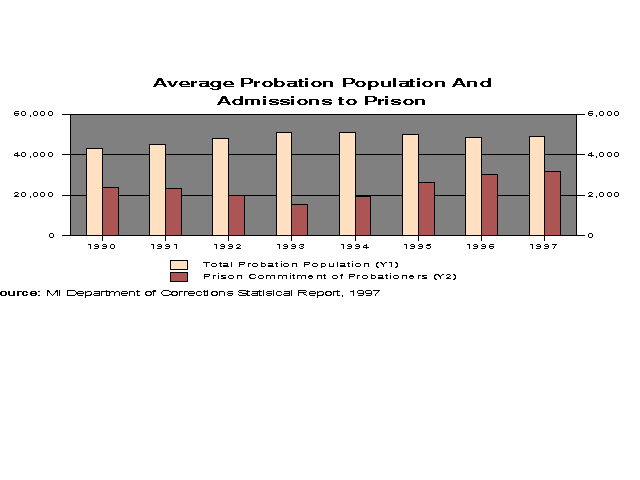
As Figure 2 shows, the circuit court
probation population increased from 1990 to 1994 by 18%. In 1995, the number
of offenders under supervision began to decrease and that decrease continued
through 1997. On the other hand admissions to prison of offenders on probation
decreased from 1990 to 1994 by 19%. In 1995, the number of probation admissions
to prison sharply increased and continued through 1997. Thus, when the
number of probations increased, the number of probation admissions to prison
decreased and when the probation population decreased, the number of probation
admissions to prison increased.
Department of Corrections' data do not separate probationers admitted to prison as the result of probation violation, from probationers admitted to prison as the result of a new sentence. Therefore, conclusions about the growth in the number of probationers admitted to prison are difficult to reach. However, the trend seems to indicate that the number of offenders on probation increased as new community-based sanctions were implemented. As more offenders were diverted from prison, the probation population increased. The causes of decrease in the probation population since 1995 may be related to the decreased crime rate. In this case, the decrease in the number of offenders reduces the pool of offenders available for probation.
On the other hand, to the extent that more offenders were diverted from prison to probation, more offenders should fail on probation. If more offenders with a higher risk for reoffending are placed on probation because there are more programs that address their needs, then the probation failures as a percentage of total probation population should increase. However, the number of probationers failing on probation as a percentage of the total number of probationers decreased until 1996, suggesting that other factors may be afoot.
Since FY 1994-95, the Legislature has enacted
in the Department's budget act a workload unit(6)
per agent to offender ratio of 90:1. With the additional funding, field
agents were expected to supervise probationers and parolees more effectively,
guiding them to successful completion of probation or parole. However,
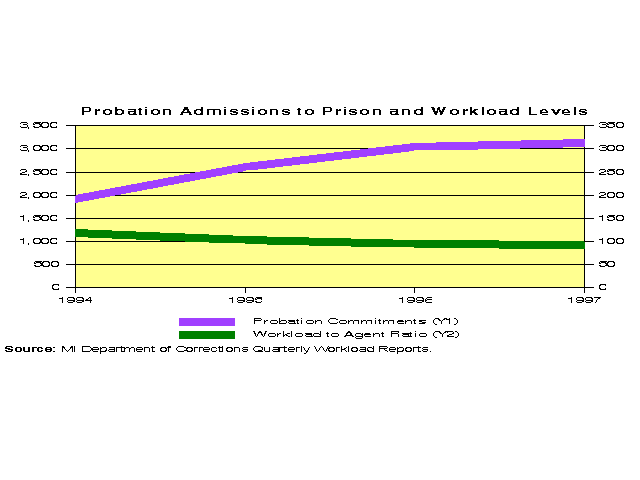
as the average number of supervised workload units decreased, the number
of probationers admitted to prison increased, as seen in Figure 3.
It appears that the additional agents may have led to increased detection
of probation violations, and sped the return of probation violators to
prison.
A prisoner is eligible for parole after serving a minimum sentence or a minimum sentence less good time or disciplinary credit. The parole board decides when a prisoner is ready for release from prison to the community before the prisoner serves the crime's maximum sentence. The parole board's decision is guided both by statute and by guidelines established by the Department of Corrections according to statute. Also, the parole board may not release a prisoner until the "...board has satisfactory evidence that arrangements have been made for such honorable and useful employment as the prisoner is capable of performing, for the prisoner's education, or for the prisoner's care if the prisoner is mentally or physically ill or incapacitated". [MCL 791.233(1)(e)]
Under current practice, the field agent
and agent supervisor are responsible for managing the parolee in the community
by utilizing community sanctions, such as intensive supervision, to reprimand
behavior in violation of parole. When, as the result of technical violation(s)
or new criminal behavior, it appears that the parolee can no longer be
managed in the community, the agent writes up the technical violation(s).
An area manager receives the paperwork and evaluates whether the parolee
should be returned to prison for a parole revocation hearing before the
parole board, or placed in a Technical Rule Violation Center.(7)
If the parolee successfully completes the three-phase program at the Technical
Rule Violation Center, he is returned to the community and the technical
violation(s) is discharged. A parolee can be incarcerated without warrant,
but must have a preliminary hearing 10 days after arrest. Parolees
returned to prison are entitled to a fact finding hearing before one member
of the parole board within 45 days of return, according to State law. A
parolee committing a new crime is prosecuted at the discretion of the county
prosecutor, with the sentence determined by a circuit court judge.
Figure 4
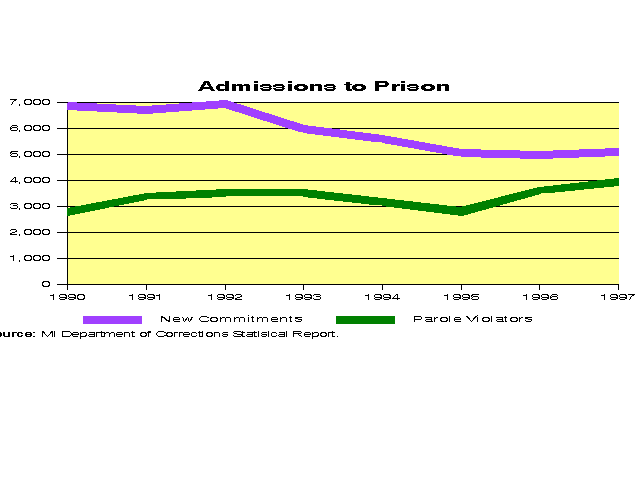
Figure 5 shows that parole technical rule violator returns to prison increased from 25% of the supervised parole population in 1990 to 32% in 1997. On average, a third of the supervised parole population will be returned to prison with a new sentence or with a technical rule violation. Also, Figure 5 illustrates that there are fewer parole violators with new sentence admissions to prison than there are parole technical rule violator admissions and that the number of parole technical rule violator admissions to prison is increasing.
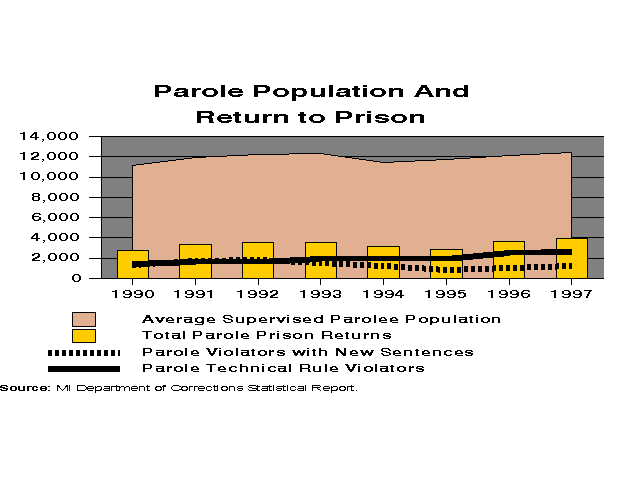
The admissions of parole violators with new sentences seemed to decline when a 1993 ruling by Wayne County's Recorders Court required a parolee to complete the full maximum sentence for the original crime, as well as the minimum sentence for the new crime. Since the overturn of that ruling in 1996, admissions of parole violators with new sentences have increased. Prison admissions of all parole violators increased even during the period the ruling was in effect, suggesting that parole violators who would have returned to prison with new sentences prior to the ruling, were probably returned to prison as parole technical rule violators as a result of the ruling.
Moreover, the overall admissions of parole violators to prison suggest that this segment of the prison admissions should be a growing corrections concern. In addition to prison admissions, some parole technical rule violators do not return to prison, but rather serve a 90-day sanction in a Technical Rule Violator Center. In 1997, there were 1,929 terminations from incarceration in the Technical Rule Violator Center with 169 unsuccessful terminations(8). This means that there were an additional 1,760 parole technical rule violators not reflected in the admissions to prison.
The growth of parole technical rule violators
may be caused by a situation similar to probation violators: The increase
in the number of field agents may have resulted in increased detection
of technical rule violations and new crimes. It is important to recognize
that parole technical rule violators are subject to the rules and conditions
established by the parole board and the parolee is subject to the policies
of enforcement developed by the Department of Corrections, based on statute.
Changes in these policies or in the application of the policies may result
in more offenders returning to prison.
Typically, one thinks of an offender going to prison as a result of a finding of guilt by the court. Although a large number of admissions to prison do result from new commitments, the number of offenders already involved in the corrections system who are returned to or enter prison is on the rise and becoming a more important force in determining the growth of the prison population. The length of sentence of new commitments will be increased as sentencing guidelines and truth-in-sentencing laws take effect, but the length of sentence for offenders already involved in the corrections system is not affected by these new laws.
As the number of offenders returned to
or entering prison as the result of a technical violation continues to
increase, the policies affecting these offenders become important in determining
the make-up and growth of the prison population. The number of parole and
probation agents, as well as the direction that those agents receive, could
become an increasing focus of public policy discussions about the growth
of the prison population in the future.
2. Correctional facilities operated or contracted by the State are "prisons" and locally operated correctional facilities are "jails".
3. For uniformity of reporting information, eight offenses (murder, rape, robbery, aggravated assault, burglary, larceny, motor vehicle theft, and arson) are reported by law enforcement agencies nationwide. These offenses are referred to as index crimes and, based on the seriousness of the crimes, a change in frequency of their occurrence is an indication of national trends in crime. Other offenses are called nonindex crimes, and together the index and nonindex crime rates sum to the total crime rate. Both index and nonindex crime rates are reported in the Uniform Crime Report, issued annually by the Michigan State Police.
4. Circuit court probation agents are funded through the Department of Corrections budget. Probation, as discussed in this paper, refers to circuit court probation in most cases because the supervision is provided by the State. However, jails or other local resources may be used by both district and circuit court judges and the State interest in decreasing prison admissions may result in funding of programs that target district court probation.
5. Special alternative incarceration is also known as boot camp. This sanction is not community-based, because offenders are removed from the community to a centralized camp. However, at the conclusion of the centralized program, the offender is returned to the community and may receive intensive supervision.
6. The supervision of certain parolees or probations may be more or less intensive. A workload unit weights the amount of supervision required by the offender to better define the amount of work, rather than the number of cases, a field agent handles. Also, field agents are probation and parole agents. In some counties, the probation agent and the parole agent are the same person. In larger counties, the agent functions may be separated and agents may even operate out of separate offices.
7. Since 1993, the Legislature has funded three Technical Rule Violation Centers to provide a 90-day sanction for parole technical rule violators without having to return the parolee to prison. There are 554 beds in the facilities combined, which, assuming a 90-day sanction, can be turned over four times a year, for a total of up to 2,216 additional incarcerations per year for parole technical rule violators.
8. An unsuccessful termination probably results in a prison term and therefore becomes part of the parole violator admissions to prison.